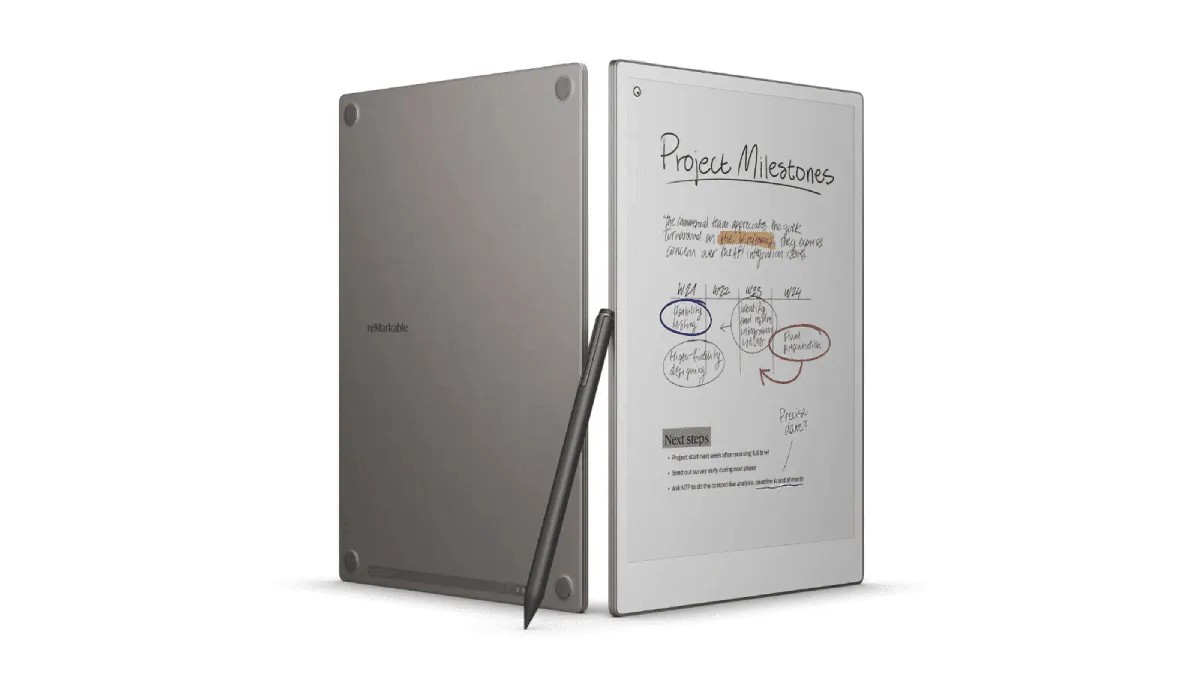
Two devices. Both are 10.3-inch color E Ink tablets built for handwritten notes and PDF reading. Both cost around $500-580. Both have front lights, premium pens, and the ambition to replace your paper notebooks entirely. And yet they could not be more different in philosophy.
Spec Comparison
| Feature | reMarkable Paper Pro | Boox Note Air 5C |
|---|---|---|
| Screen | 11.8” Canvas Color, 229 PPI | 10.3” Kaleido 3, 300/150 PPI |
| OS | Linux (custom) | Android 13 |
| Apps | None (purpose-built) | Full Play Store |
| Storage | 64 GB | 64 GB |
| Weight | 525g | 420g |
| Battery | 2 weeks | 1-2 weeks |
| Stylus | Included | Included |
| Price | $579 | $499 |
The reMarkable Paper Pro is a focused tool. It does one thing — writing on digital paper — and pursues that goal with monastic intensity. There is no app store, no web browser, no email client. It feels like a physical object, not a computer.
The Boox Note Air 5C is a generalist. It runs full Android 13, which means it can do everything the reMarkable can and much more — run Kindle, read EPUBs in KOReader, access Google Drive, browse the web, install any app from the Play Store. It is more powerful, but that power comes with complexity.
Which one is right for you depends entirely on what you value: purity of experience or versatility.
Writing Feel: The Core Experience
This is the reMarkable Paper Pro’s strongest card, and it is not close. Writing on the Paper Pro feels like a really nice ballpoint pen on a thick legal pad. The surface has a subtle texture that provides just the right amount of friction. The Marker tip has a soft give to it, and the latency is 12ms — imperceptible in daily use. After writing on the Paper Pro, an iPad with Apple Pencil feels like tapping on glass.
The Boox Note Air 5C has a good writing experience, but it is a step behind. The surface is smoother, more like a fine-grain hardcover book. The latency is slightly higher (around 20-25ms), which is still fast enough for note-taking but does not have the same “disappears into the experience” quality that the Paper Pro achieves.
If writing feel is your number one priority — if you are a writer, a journaler, someone who misses the physicality of pen on paper — the Paper Pro wins decisively.
PDF Reading and Annotation
For reading and marking up documents, the two devices are much closer. Both have 10.3-inch screens that display PDFs at a readable size without zooming. Both support pen annotation directly on PDFs.
The Boox pulls ahead in software. Its built-in NeoReader can reflow PDF text, split two-column layouts into single-column views, crop margins, and handle scanned documents. You can install cloud storage apps (Dropbox, Google Drive, OneDrive) and sync documents directly. The Play Store gives you access to Zotero for academic reference management, which is a genuine game-changer for researchers.
The reMarkable handles PDFs beautifully as static documents for reading and markup, but the software is more limited. No text reflow, no column splitting, no third-party app integration. You read the PDF, you mark it up with the pen, you are done. For simple annotation workflows, this works well. For heavy academic use with hundreds of papers, the Boox is more practical.
Reading Books
This is where the Boox pulls far ahead. The Note Air 5C can install the Kindle app, the Kobo app, KOReader, Libby, and any other reading app from the Play Store. You can read books from any ecosystem, in any format, with full features — dictionaries, highlights, sync across devices. It is essentially every e-reader in one device.
The reMarkable Paper Pro can open EPUBs and PDFs, and that is about it. EPUB reading is bare-bones: font size and margin adjustment, no dictionary, no bookstore integration, no library borrowing, no highlights sync. The reMarkable is not designed to be an e-reader, and it shows.
If reading books is a significant part of how you will use the device — and for most people, it is — the Boox is the better choice.
Battery Life
The Paper Pro lasts about two weeks of daily note-taking and occasional reading with the front light on. The Boox Note Air 5C lasts about one week under the same conditions. The difference is Android: background processes, app sync, and Google Play Services all consume power even when you are not actively using them.
If you are diligent about closing apps, turning off Wi-Fi, and managing background processes, you can push the Boox closer to 10 days. But the reMarkable’s longer battery life is a real advantage for users who want a device that just works without power management concerns.
Build and Design
Both are beautifully built. The Paper Pro is slightly thinner (5.1mm vs 5.8mm) and lighter (525g vs 535g). The Paper Pro’s Mosaic weave folio is a standout accessory — expensive at $79 but beautifully designed and functional. The Boox has a more utilitarian design with a wider bezel on the left side for secure one-handed holding.
Who Should Buy Which
Buy the reMarkable Paper Pro if:
- Writing feel is your absolute top priority
- You want a distraction-free tool, not another computer
- You do not need to install apps or read Kindle books
- You value simplicity and focus over versatility
Buy the Boox Note Air 5C if:
- You need to read books from multiple ecosystems (Kindle, Kobo, Libby)
- You want to install productivity apps (Zotero, cloud storage, RSS readers)
- You read a lot of PDFs and need text reflow and column splitting
- You are a student or researcher who needs device integration with a workflow
If I had to choose one for myself, it would be the Boox. The ability to read Kindle books and annotate PDFs with Zotero on the same device that takes my handwritten notes is too useful to give up, even if the writing feel is slightly less magical. But if you are a pure writer who wants the closest possible experience to pen on paper, the Paper Pro is unmatched.
Frequently asked questions
Which is better for students, reMarkable or Boox?
Boox Note Air 5C is better for most students because it runs Android and can install research apps, cloud storage, and PDF management tools. The reMarkable is better for students who primarily hand-write notes and want the most paper-like feel.
Can reMarkable Paper Pro read Kindle books?
No. The Paper Pro does not support Kindle DRM and has no access to the Kindle Store. It can read DRM-free EPUBs but offers a basic EPUB reading experience. The Boox Note Air 5C can install the Kindle app from the Play Store and read all Kindle books natively.
Does the Boox Note Air 5C have a better screen than the reMarkable Paper Pro?
The screens use different technologies. The Paper Pro uses E Ink Gallery 3 with 300 ppi for both B&W and color. The Note Air 5C uses Kaleido 3 with 300 ppi B&W and 150 ppi color. For B&W text, both are excellent. For color, Paper Pro has sharper color but slower refresh.